What is an Ember?

Understanding embers and how they ignite homes in wildfire events.

What Is an Ember?

Many people imagine embers as glowing coals in a campfire or fireplace. In the context of wildfires, embers (also called firebrands in fire science) are any burning particles of wood, bark, pinecone or man‑made material that are larger than a few millimeters and smaller than a football. These fragments can be as small as a fingernail or as large as a fist; exceptionally large embers from man‑made materials have been documented at 3 feet wide in research, including a documented case from the 2021 Marshall Fire where a burning piece of a child's plastic playhouse traveled a quarter mile.

Carried by wind, embers may travel hundreds or even thousands of feet—sometimes several miles ahead of the fire front, a phenomenon known as spotting. Under extreme wind conditions, firebrands can be lofted high into the atmosphere and transported significant distances. They can land on roofs or enter homes through attic vents, where they ignite materials quietly out of sight. By the time flames are visible, the structure is often beyond saving.
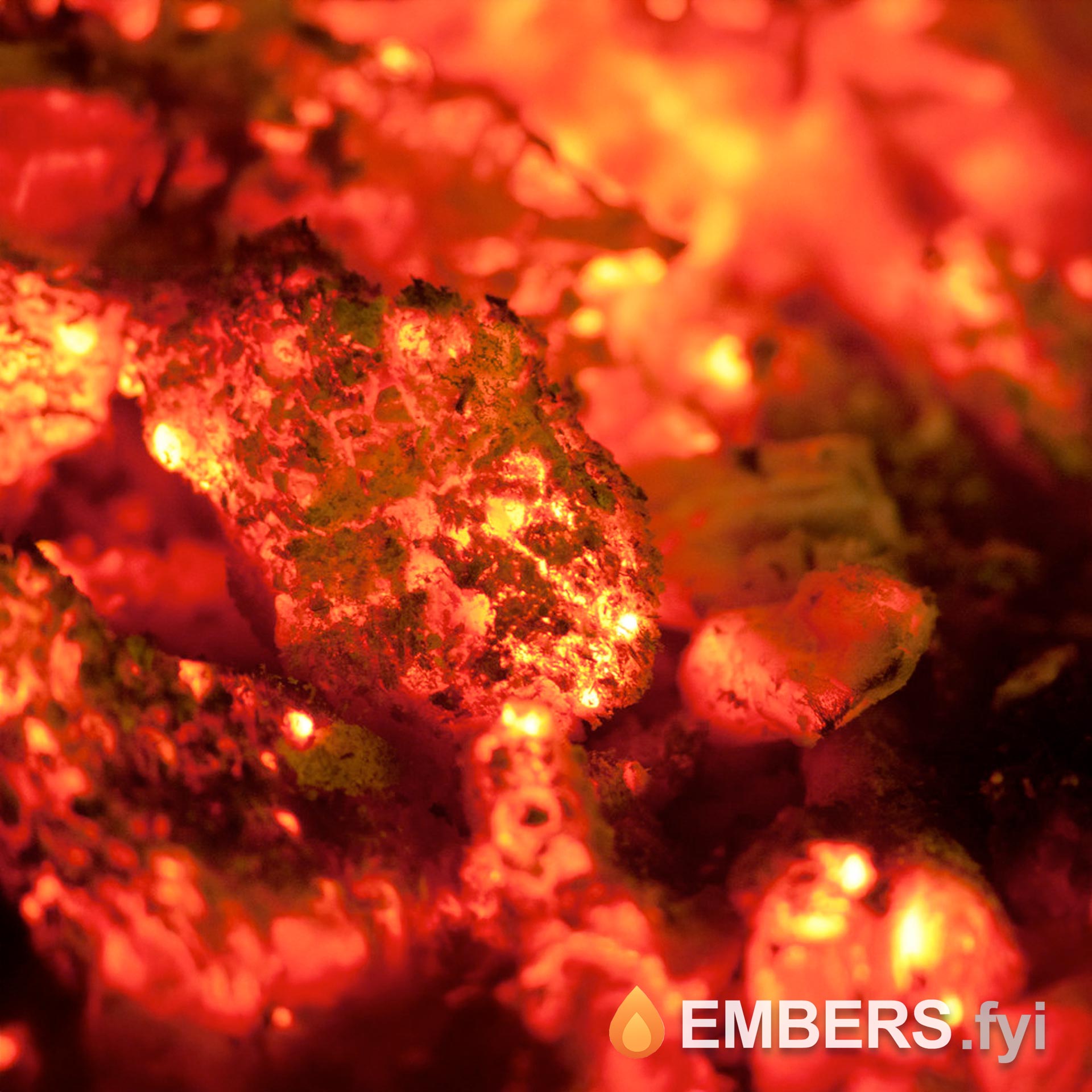

Close‑up view of glowing red embers in a fire
Glowing embers carried by wind above a mountainside fire at dusk
A mountainside wildfire near California's Rainbow Bridge sends glowing embers high into the evening sky, illustrating how firebrands can travel long distances ahead of the flames.

Those strong wind gusts help loft and transport embers, which is what's responsible for most of the building damage. It's not necessarily always this big wall of flame but rather embers transporting long distances and landing on some kind of fuel nearby or directly landing on a building.

Dr. Tirtha Banerjee, Assistant Professor of Environmental Engineering, UC Irvine
Dr. Banerjee specializes in fluid dynamics and environmental flows, with research focused on wildfire behavior and ember transport mechanisms.

Why Are Wildfire Embers Dangerous?

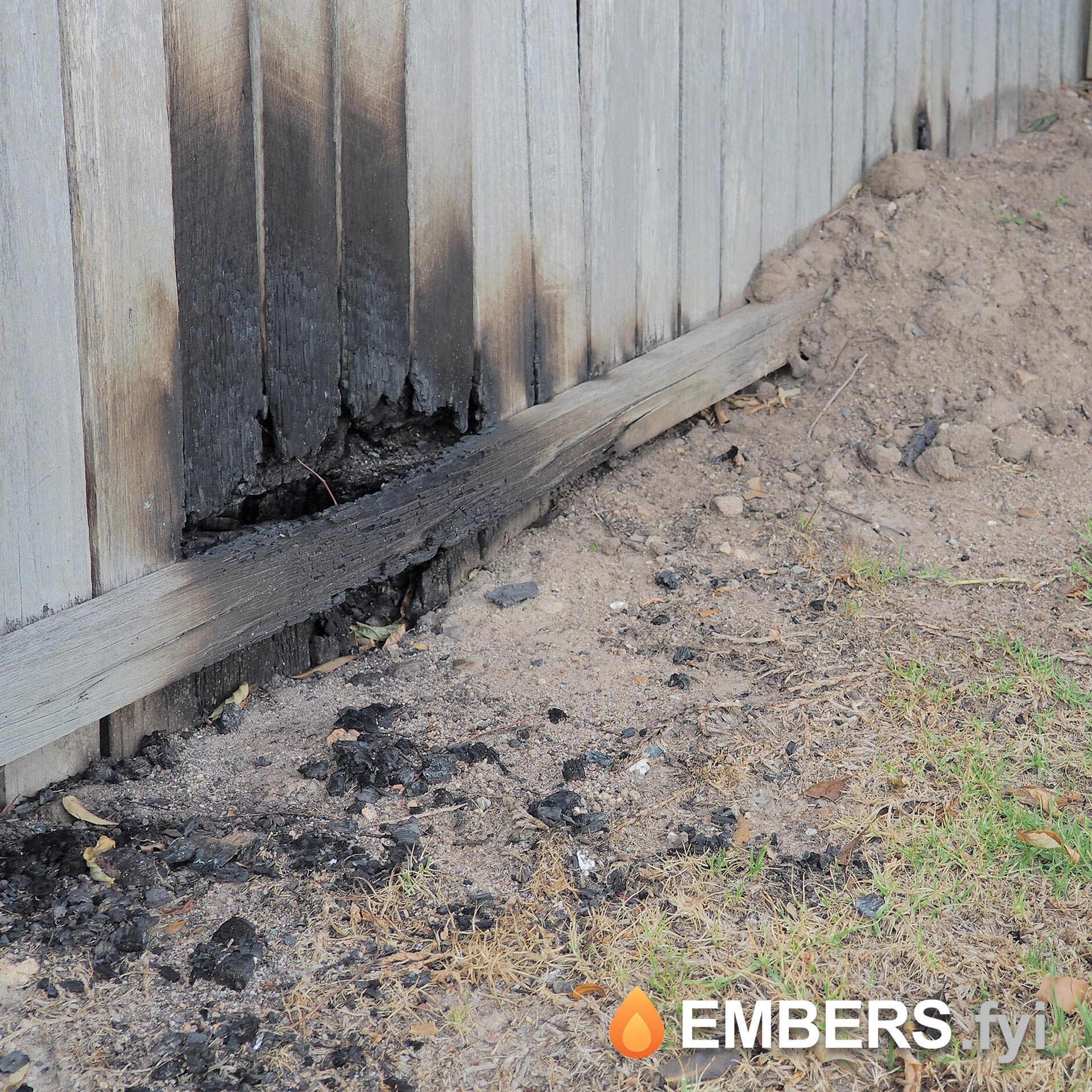
Wooden fence severely charred and damaged by embers
  • Varying size: Embers typically range from 2 mm (smaller than a pea) to pieces as large as a fist or bigger. Most are small (millimeter to centimeter scale), but larger structural debris can occur. Even small embers can ignite dry leaves, wood shavings, pine needles, insulation or other debris.
  • Intense heat: They retain enough heat to ignite combustible materials wherever they land.
  • Travel far: Embers may travel miles ahead of the main fire. Laboratory and field studies from NIST (National Institute of Standards and Technology) have documented spotting potential of several miles and even tens of kilometers in extreme cases. Wildfires can generate millions of embers that land on and around homes, triggering spot fires minutes or hours after the main front passes.

Multiple studies show that embers, not direct flames, are responsible for most home losses in wildfires. Research by IBHS (Insurance Institute for Business & Home Safety) and NIST confirms that 60–90 percent of homes lost in wildfire events ignite because of embers, with the exact percentage varying by event. California's Office of the State Fire Marshal (OSFM) officially cites this 60–90% range. NIST case studies have found 54%–66% ember-caused destruction in specific fires.

More than 90% of homes catch on fire due to embers, not direct flame, so that is what we highly focus on… When you harden your home, it makes that whole area safer. We call that a resiliency effect.

Deanna Fernweh, Lake County Home Hardening Program
The Lake County Home Hardening Program provides free home assessments and retrofits to wildfire-prone communities in California, focusing on ember-resistant improvements.

Why Embers Destroy So Many Homes

Homeowners often picture siding catching fire from a wall of flames. In practice, embers are usually the first and most significant threat. Wind‑driven embers can penetrate vent openings and gaps that flames cannot reach. Once inside, they can smolder for hours, igniting attics, crawl spaces or other concealed areas. Because embers travel far and land indiscriminately, they trigger spot fires beyond the main flame front; this is why neighborhoods miles from a wildfire can be showered with embers. Millions of embers can land on a single structure and a single ember ignition can start a catastrophic chain of events.

High‑quality ember‑resistant screens can block approximately 93–98% of embers (based on peer-reviewed testing from the University of Southern Queensland under specific wind and fuel conditions) and reduce radiant heat by approximately 38% (product- and test-specific results from laboratory testing), underscoring how effective vent treatments are. Performance depends on mesh aperture, installation quality, wind and ember characteristics, and orientation.

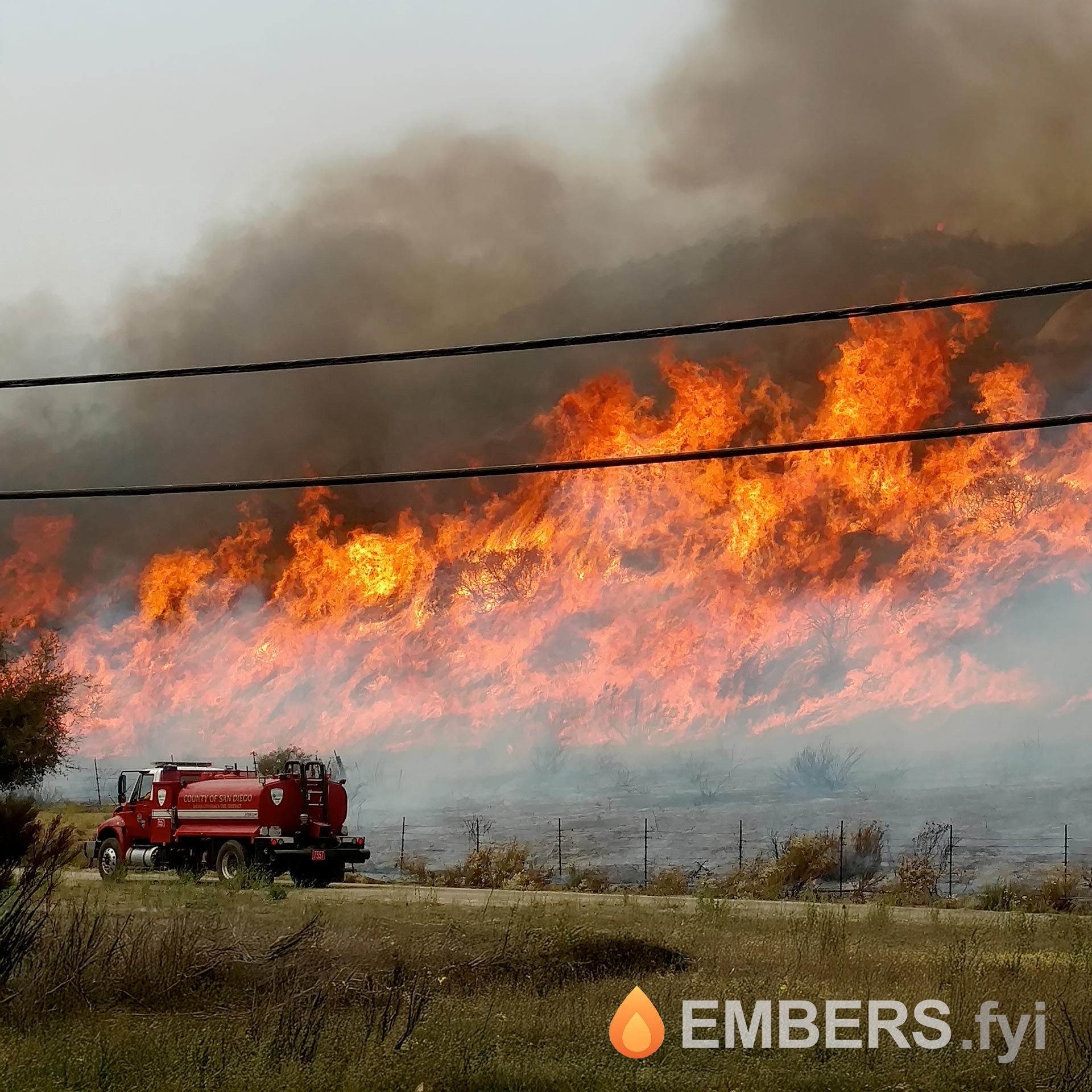
Wildfire with large flames and fire truck responding near the border in San Diego
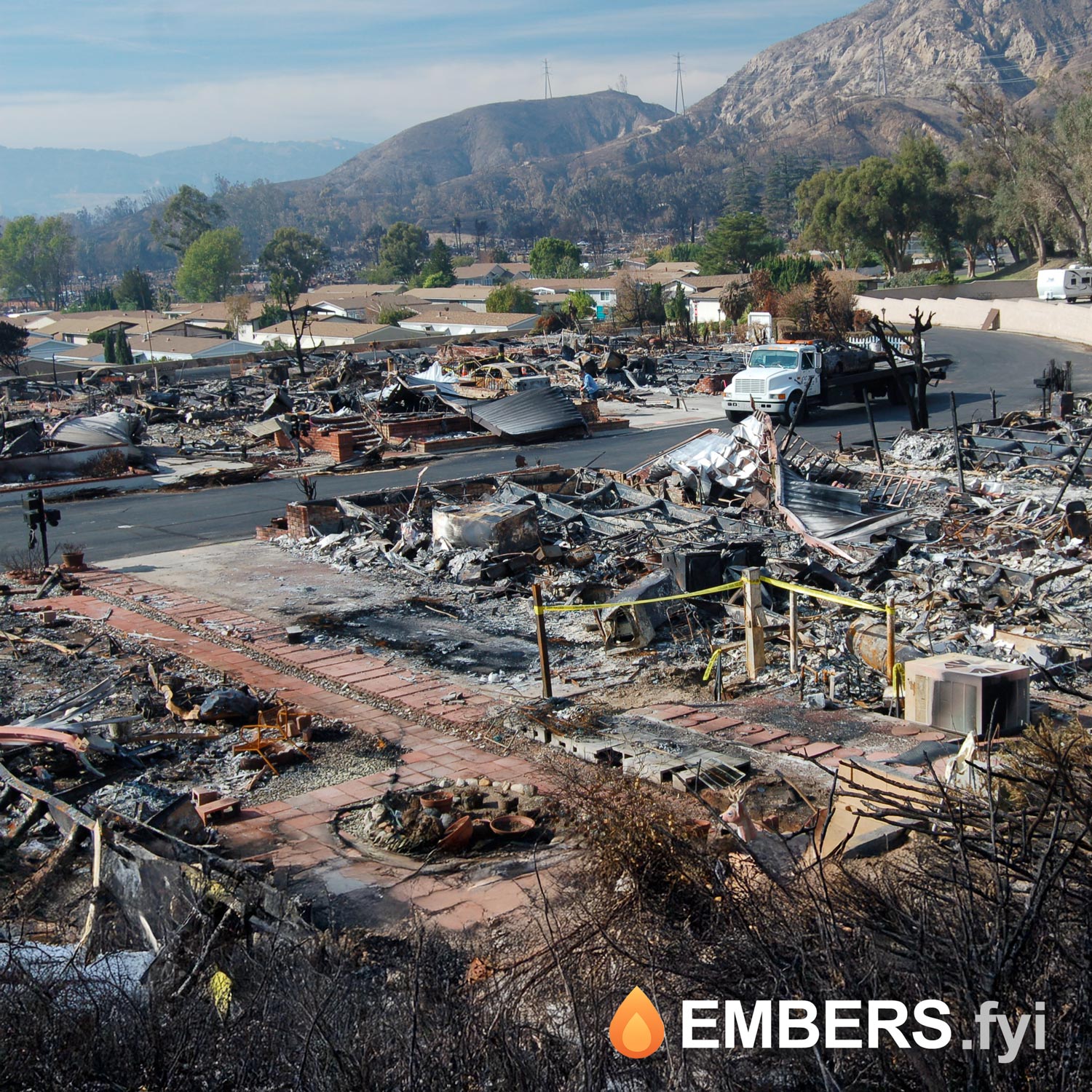
Aftermath of a mobile‑home park destroyed by wildfire in Sylmar, California
A mobile‑home neighborhood in Sylmar, California was reduced to rubble after a wildfire. Wind‑driven embers ignited structures hours before the main flame front, demonstrating how ember attacks can devastate entire communities.

How Do Embers Get Into Homes?

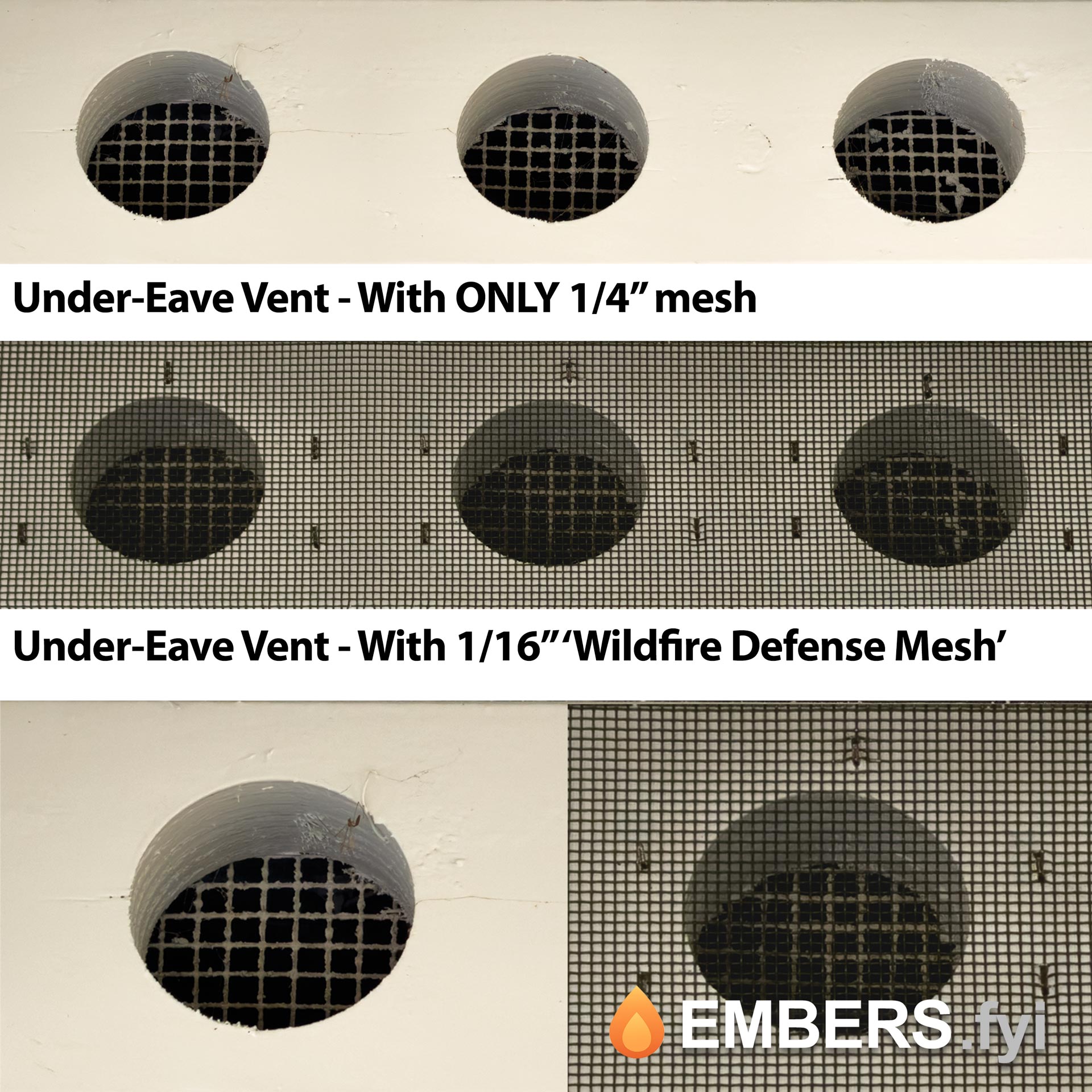
Comparison showing different vent mesh sizes from standard to ember‑resistant

Embers behave like fine airborne particles. Air currents draw them through openings and vents. Typical entry points include gable vents, soffit or under‑eave vents, foundation/crawl‑space vents, roof‑edge gaps and areas under decks or patios. IBHS and NIST testing has repeatedly shown vent vulnerability to wind‑driven firebrands. Homes built before modern wildfire codes often have large vents covered with ¼‑inch pest mesh, which is too coarse to stop embers.

CAL FIRE recommends covering vents with noncombustible, corrosion‑resistant metal mesh between 1/16 and 1/8 inch and, ideally, replacing vents with fire‑rated, ember‑resistant models that meet California State Fire Marshal approval for flame and ember resistance. Note: California's Chapter 7A building code (updated effective July 1, 2021) requires vents listed and tested to ASTM E2886 for new construction and many retrofits in Wildland-Urban Interface (WUI) areas. Homeowners should confirm requirements with their local building official or Authority Having Jurisdiction (AHJ).

Creating a "Zone 0" or ember‑resistant zone within 0–5 feet of a home using gravel, concrete or brick, and keeping this area free of woodpiles or flammable plants, reduces the chance of embers finding fuel. A 2021 analysis of 71,000 properties by IBHS and Zesty.ai found that clearing vegetation right next to structures can nearly double a home's chance of surviving a wildfire. California's Office of Emergency Services (OES) highlights Zone 0 as the most important defensible‑space zone.

As the leading cause of home ignition, embers often travel miles ahead of the fire front and can accumulate at the base of a structure.

Steve Hawks, Senior Engineer, Insurance Institute for Business & Home Safety (IBHS)
IBHS conducts full-scale ember storm simulations and structure testing at their research facility in South Carolina to develop wildfire mitigation strategies.

What Are Ember Attacks?

An ember attack occurs when wind‑driven embers shower a structure over an extended period. Federal and research sources describe ember showers that last for extended periods, with embers smoldering out of sight and igniting structures hours after the flame front. These embers lodge in leaves, cobwebs, bird nests, stored items and insulation, smoldering and igniting fires far from the main wildfire front. Millions of embers can impact a single neighborhood and one structure ignition can trigger structure‑to‑structure spread. A home strengthened against ember attacks allows embers to land and cool without igniting anything. This protection benefits not only the individual house but the broader neighborhood.

It's all about the embers and making sure they have nothing combustible to land on. Embers can fly for miles ahead of the wildfire front. If they get inside a home through vents or an open or broken window, they can ignite a new fire which can then consume that home and start a chain of fires within a neighborhood or community.

Daniel Gorham, Research Engineer, Insurance Institute for Business & Home Safety (IBHS)
Gorham leads IBHS's wildfire research program, conducting live-burn demonstrations and developing evidence-based home hardening recommendations.
Large plume of smoke rising from the 2018 Carr Fire wildfire in Shasta and Trinity counties, California
A house burning fiercely at night while a U.S. flag waves in the foreground
A home burns to the ground while an American flag hangs nearby. Ember showers can start fires miles from a wildfire's main front, triggering a devastating chain reaction of structure‑to‑structure ignitions that can overwhelm firefighting resources.

What Is an Ember‑Resistant Vent Screen?

Examples of ember‑resistant vent screens showing fine mesh construction

Ember‑resistant vent solutions are essential for preventing embers from entering your home.

  • Ember‑resistant vents: Replace existing vents and employ baffles or plates to slow and cool embers. CAL FIRE and IBHS recommend using vents that meet California State Fire Marshal approval for flame and ember resistance. For new construction and many retrofits in WUI jurisdictions since July 1, 2021, California requires ASTM E2886‑listed vents.
  • Ember‑resistant vent screens: Metal mesh panels mounted over current vents. Brands like Wildfire Defense Mesh and Ember Mesh use woven stainless‑steel fabric tested to block embers while allowing airflow. Independent testing shows these meshes stop approximately 93–98% of embers (University of Southern Queensland peer-reviewed testing under specific conditions) and reduce radiant heat by approximately 38% (specific product laboratory testing). Real‑world performance depends on mesh aperture, installation quality, wind and ember characteristics, and orientation (vertical vs. horizontal).

These screens are typically made of powder‑coated 304 stainless steel with an aperture of approximately 0.065 inches (within the 1/16 to 1/8 inch range), complying with Chapter 7A of the California Building Code. They're durable, corrosion‑resistant and easy to install. Mesh products can be part of listed assemblies or used in certain vertical applications; code compliance depends on listing and installation details.

…mesh with no more than one‑eighth inch gaps — any bigger and embers could get inside and burn the house down.

Steve Hawks, Senior Engineer, Insurance Institute for Business & Home Safety (IBHS)
Hawks emphasizes that proper mesh size is critical—standard ¼-inch hardware cloth allows dangerous embers to pass through.

I made my parents put ember‑resistant vents on their home. That's a pretty high‑yield, low‑cost intervention that a lot of people can just do themselves

Dr. Daniel Swain, Climate Scientist, UCLA
Dr. Swain is a leading expert on California weather extremes and wildfires. His personal recommendation underscores the effectiveness and accessibility of vent hardening.

Standard Sizes and Installation

Standard Sizes:

  • Small exhaust vents: usually 7–8 inches square; avoid screening dryer vents because they have self‑closing flaps and screening can interfere with proper operation.
  • Under‑eave or soffit vents: long strips, roughly 22 inches wide and 3–6 inches tall; cut mesh strips slightly larger and trim on site.
  • Foundation/crawl‑space vents: often 8 × 16 inches; measure each vent to determine mesh size.
  • Gable vents: typically around 14 × 24–28 inches; large vents may require mesh about 24 × 36 inches.
  • Dormer vents: half‑dome vents on roofs; measure width and height for circular cuts.

Installation Tips:

  • Install from the outside; secure screens directly over vents with non‑corrosive screws, nails or staples.
  • Leave existing pest mesh in place as a second layer unless it interferes with installation.
  • Cut screens slightly oversize and trim for a clean fit; have extra mesh available for unexpected vents.
  • With planning and basic tools, most homeowners can install screens on several vents in a single afternoon.
  • Important: Always verify local code requirements and manufacturer instructions, especially regarding vent listings, airflow requirements and prohibited applications. Consult your local building official or Authority Having Jurisdiction (AHJ) to confirm compliance.
Wildfire flames with fire truck responding in San Diego border area

Who Made This Site and Why

Embers.fyi is maintained by professionals who install ember‑resistant vent solutions in wildfire‑prone communities. We share test results, product information and installation tips based on field experience with materials like Wildfire Defense Mesh and Ember Mesh. Our goal is to answer "what is an ember" and provide practical guidance so homeowners can better protect their properties from ember attacks and create safer, more resilient communities.